Batman vs Superman: Who Really Defines Justice?
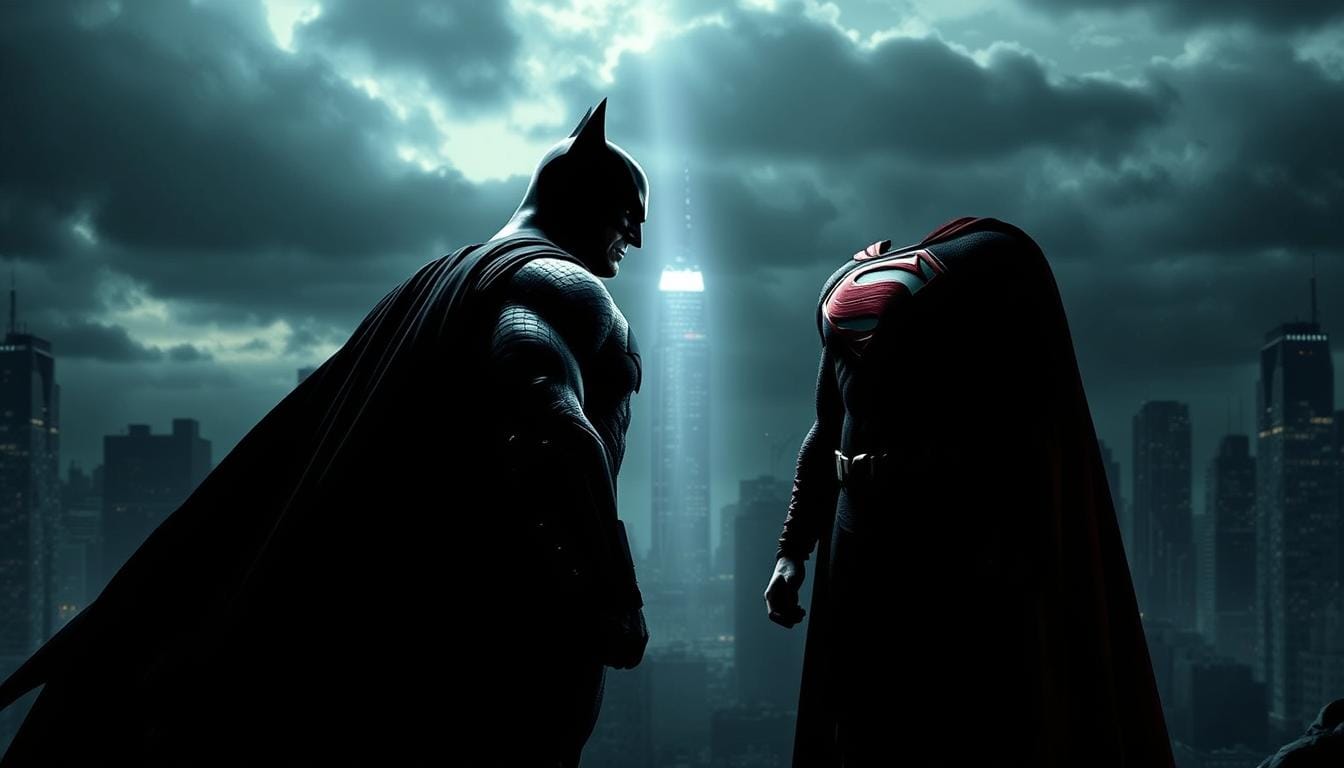
This introduction sets the stage for a head-to-head look at two iconic approaches to justice on screen. The article compares methods, impact, and ethics to see which philosophy resonates with audiences and critics.
Batman vs Superman and their clash in Dawn of Justice sparked wide debate when the movie hit the public eye. The film’s release divided critics and people: it holds a 28% Tomatometer and a 63% Audience Score on Rotten Tomatoes, and it now streams on Max or can be rented on Fandango at Home.
We will focus on what the film shows on screen — story beats, performances, direction, and production choices — rather than comic-only histories. The guide question is simple: how do two icons interpret justice differently, and what does that difference mean for the world they inhabit?
This piece aims to be balanced and evidence-driven. Using runtime, reception, and on-screen moments, we will weigh the original idea against how effectively the film executes it.
Key Takeaways
- Compare tactics and tools each character uses to pursue justice.
- Measure impact by collateral damage, deterrence, and public sentiment.
- Assess ethical stances: accountability, transparency, and proportionality.
- Use film details and production choices to inform interpretation.
- Position reception data to anchor a fair, professional evaluation.
Why This Batman vs Superman debate still matters
The clash is more than a fight scene; it asks how societies judge power after disaster.
Past context: From Man of Steel to Dawn of Justice
Man of Steel left a ruined city and a public asking hard questions about unchecked power. The 2013 climax framed a new baseline for damage, and dawn justice picks up that fallout.
The sequel, directed by Zack Snyder and released on March 25, 2016 in formats like IMAX 15/70mm, reframes the aftermath through a witness on the ground—Bruce Wayne. This angle forces the plot to interrogate cost, accountability, and restitution after large-scale urban destruction.
Setting expectations for a comparison
Over several years, debate about collateral damage in superhero movies raised audience expectations for accountability. This piece will methodically weigh each hero’s approach rather than treat them as interchangeable.
- Connect character intent to public impact in the film’s world.
- Map on-screen events to social trust and political oversight.
- Compare tactics against the same city problems to reveal philosophical rifts.
We will not ask who wins a brawl. Instead, we will test which framework for justice holds up under narrative pressure and the lived experience of the people in the story.
Defining “justice” in Gotham versus Metropolis
Gotham and Metropolis offer different blueprints for justice, each tied to its threats and civic expectations.
Batman’s deterrence and fear-based vigilantism
Bruce Wayne responds to danger by shaping the environment of fear. He acts on the ground after the Metropolis battle, rescuing survivors and carrying trauma back to his city.
In Gotham, the way to prevent harm is preemption: tracking suspects, branding symbols, and asserting control before a threat reaches innocent life.
Superman’s moral absolutism and public accountability
Clark Kent frames justice as saving life first and accepting scrutiny later. His public appearance at a Senate hearing after international incidents highlights transparency over secrecy.
Metropolis demands that heroes answer to institutions, even when that scrutiny complicates urgent decisions.
Criteria we’ll use to compare method, impact, and ethics
- Methods: tools, surveillance, and preemption versus restraint and visibility.
- Impact: collateral damage, deterrence, and institutional trust.
- Ethics: accountability, proportionality, and civil rights in a changing world.
From page to screen: How Snyder frames the clash
Zack Snyder turns comic-book myth into a widescreen argument about power. He stages the meeting as an arena where image, ideology, and public spectacle decide meaning.
“The greatest gladiator match in the history of the world: God versus man; day versus night; Son of Krypton versus Bat of Gotham,”
“The greatest gladiator match” — Lex Luthor’s thesis
Lex Luthor compresses the story into a symbolic duel. That line makes the conflict readable: a public contest where reputation and belief are weapons.
The gladiator framing forces both figures into roles shaped by media, fear, and expectation. It turns private motives into a staged debate for a watching world.
Visual tone, IMAX scope, and effects-driven spectacle
The film uses IMAX 15/70mm scale, high-contrast palettes, and stylized compositions to dramatize difference.
Effects-heavy scenes act as visual arguments: sound, color, and pacing mark power and vulnerability. Snyder’s direction favors operatic stakes, which can polarize viewers but keeps thematic focus tight.
- Large-format framing makes consequences feel public and inevitable.
- Sound and color cues guide emotional judgment during each encounter.
- Stylistic excess sparks debate about intention versus spectacle.
Batman’s way: Bruce Wayne’s playbook for order
After the Metropolis fallout, Bruce Wayne rewrote his playbook to prioritize preemption and deterrence.
Branding, preemption, and the armored countermeasure
Bruce Wayne doubles down on fear as a tool. He brands criminals and signals that consequences are certain.
The armored suit and the kryptonite arsenal mark a tactical shift. These choices show a commitment to neutralize a world-level threat, even if they risk provoking escalation.
Alfred’s pragmatism versus two decades of cynicism
Jeremy Irons’ Alfred offers calm checks on this course. He argues for moral limits and reminds Bruce about collateral life costs.
Bruce’s twenty-year weariness at night fuels a “by any means” posture. That posture accepts risky preemption when intelligence is incomplete.
- Deterrence by branding: fear-based signaling aims to reduce crime via reputation damage.
- Armored countermeasure: asymmetric tools respond to a superior adversary, but heighten escalation risk.
- Ethical cost: preemption can undermine due process and public trust in the long way.
In short, the batman superman encounter tests whether trauma-informed tactics solve problems or create new blind spots. This section will later measure outcomes against proportionality and accountability.
Superman’s way: Clark Kent’s burden of hope
Clark Kent accepts public scrutiny as the price of being seen. He shows up at oversight and answers hard questions even when opinion swings against him.
Consequences after Zod and the Senate hearing
The Africa incident and the ruins of Zod’s battle put Superman on the defensive. At a Senate hearing led by Senator June Finch, a bomb hidden in Wallace Keefe’s wheelchair explodes.
The blast kills attendees and deepens mistrust. Clark survives but faces isolation as policy makers and the public demand explanations.
Lois Lane as moral compass and narrative “key”
Lois Lane refuses to accept the official story. Her reporting links prototype bullets to LexCorp and reframes the event from random tragedy to manipulation.
This investigation re-centers facts and slows the rush to judgment. Lois keeps the search for truth central to how hope can be defended.
- Visible accountability: Clark prioritizes saving life and then taking time to face oversight.
- Ethical constraint: Self-imposed rules limit action, even as bad actors exploit legal systems to stoke fear.
- Moral partnership: Lois’ reporting and Clark’s duty form a stabilizing axis in a shaken world.
“Hope must be sustained by truth, or it becomes naiveté.”
Henry Cavill’s restrained performance communicates internal conflict without abandoning duty. The result is a method focused on rescue, de-escalation, and institutional trust — until manipulation and time pressure force hard choices.
Batman vs Superman in Dawn of Justice: the turning points
A handful of set pieces reshape intent and trust, moving the story from a duel to a fragile team response.
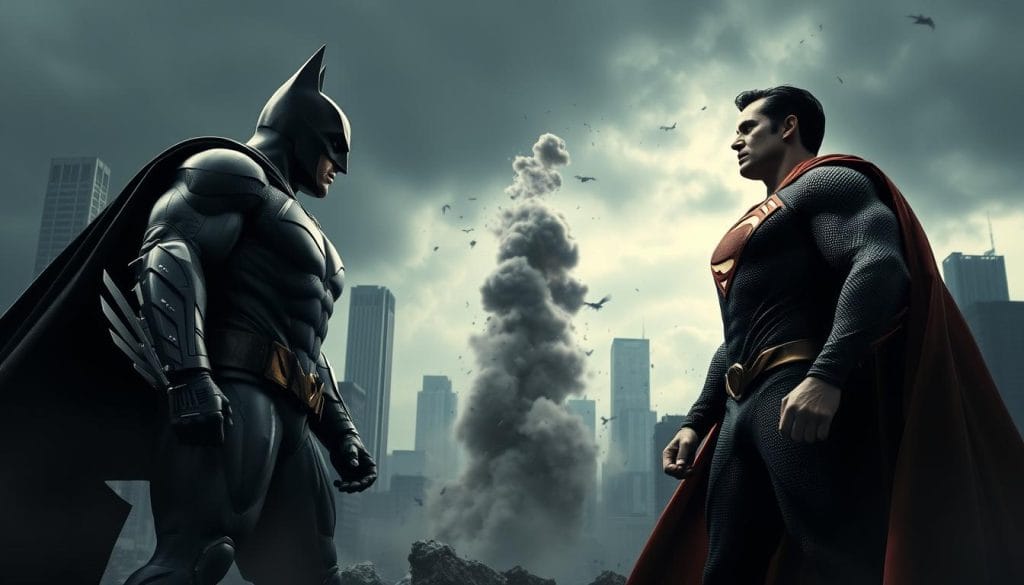
Kryptonite plan, the Bat-Signal challenge, and the warehouse rescue
The kryptonite strategy—stolen from LexCorp—crystallizes a prep-first approach. The Bat-Signal provocation turns negotiation into a planned fight that favors readiness over dialogue.
The warehouse rescue showcases peak operational skill when intelligence is accurate and objectives are clear. This scene proves tactical competence and aims to limit collateral death.
Martha, meaning, and the moment the duel ends
The duel ends on one unexpected plea: a name that reframes the target as a son saving family, not a faceless threat. That “Martha” moment cracks certainty and forces reassessment.
“One word rewrites intent and dissolves an assumed enemy.”
Doomsday escalation and Wonder Woman’s timely arrival
Lex Luthor’s manipulation is the catalytic force that brings everyone to a harsher test: the Genesis Chamber births Doomsday and changes scale.
Wonder Woman arrives and rebalances the fight, adding a focused vector of competence that tempers ego-driven escalation.
- The Doomsday battle raises stakes: the Kryptonian absorbs catastrophic risk in space.
- The trio’s brief unity symbolizes how differing methods can align against clear danger.
- These moments move the debate from “which hero is right” to “which approach adapts when new information emerges.”
Ultimate Edition vs theatrical cut: does “justice” read differently?
The extended cut reshapes how motives and consequences connect across the story’s arc. The theatrical runtime clocks 151 minutes; the Ultimate Edition runs 182 minutes. That added time restores investigative scenes and connective beats.
Runtime changes and restored connective tissue
The longer ultimate edition returns footage that clarifies causality. Africa, the Senate bombing, and manipulation threads gain explicit links. This makes culpability easier to trace.
R-rated intensity, plot clarity, and character motivations
R-rated moments add weight to choices. Toned-up scenes sharpen ethical stakes without changing the central thesis.
- Editorial pacing gives space for procedure and investigation.
- Secondary character beats align sympathy differently than the theatrical cut.
- Credit goes to chris terrio and david goyer for material that reads more cohesively with extra time.
“The added footage largely clarifies mechanisms rather than rewriting the argument.”
Overall, the Ultimate Edition makes the justice debate feel more procedural. For readers prioritizing clarity, the ultimate edition is the preferred version; the theatrical film keeps the same core but feels more impressionistic. Zack Snyder’s structure benefits from the extra minutes and helps institutional failure read more plainly.
Performances and direction: who sells the idea of justice?
How the actors inhabit their roles decides whether the film convinces us a method of justice can work. Direction and acting together make ethics feel urgent and human.
Ben Affleck’s hardened Dark Knight and Jeremy Irons’ Alfred
Ben Affleck brings physical gravitas and a weary posture that anchors the character’s tactical severity. His presence reads like long-term attrition made concrete.
Jeremy Irons functions as a moral counterweight. His dry skepticism punctures certainty and keeps judgment tethered to humanity.
Henry Cavill’s conflicted savior and Amy Adams’ investigative Lois
Henry Cavill uses restraint to show burden and scrutiny without melodrama. His choices underline rescue first, politics later.
Amy Adams drives the plot’s accountability. Her reporting reframes events and forces institutions to answer.
Jesse Eisenberg’s Lex Luthor and Gal Gadot’s scene-stealing Diana
Jesse Eisenberg plays manic intellect as precise manipulation of symbols and systems. Gal Gadot arrives with a compact, commanding energy that resets tone.
Diane Lane and Tao Okamoto add warmth and corporate texture, respectively. Together they make the director’s mythic staging feel lived in.
Conclusion: these performances sell the ethical debate. They help viewers judge which approach seems credible, necessary, and humane in the movies.
Reception and legacy: critics vs audiences, box office vs influence
The film’s cultural footprint rests as much on box office totals as on polarized reviews. That split shaped how studios, critics, and people talked about the film for years.

Rotten Tomatoes snapshot: 28% Tomatometer vs 63% Audience Score
Rotten Tomatoes records a 28% Tomatometer from 436 critic reviews and a 63% Audience Score from over 100,000 ratings. This gap highlights a sharp divide.
Critics tended to target pacing, density, and tone. Many audience members praised ambition and spectacle instead.
$874.3M global box office, DCEU setup, and Zack Snyder’s trajectory
The worldwide gross reached $874.3 million, a strong financial showing that still left studio expectations mixed.
Distributed by Warner Bros. Pictures at release, the film seeded the DCEU and led to Justice League (2017) and the later Zack Snyder project. That arc reframed the director’s public standing and studio strategy.
- Critical vs public: 28% vs 63% shows tone and structure drove polarized responses.
- Box office impact: $874.3M justified franchise moves but also prompted recalibration of creative risks.
- Legacy points: debates over death, collateral damage, and narrative density kept the movie in cultural conversation.
“Ambition and operatic scope drew both praise and complaint.”
Availability on Max and home media allowed reassessment, especially for fans who favored the longer cut. The film remains a reference point in discussions about what modern superhero movies can attempt and what people expect from franchise building.
Keyword spotlight: Batman vs Superman through the years in film and culture
Warner Bros. leaned into serialized storytelling to speed the shared universe from Man of Steel to Dawn of Justice. That move turned one film into a connective node intended to lead into Justice League and later Zack Snyder’s Justice League.
Dawn of Justice as a franchise inflection point for Warner Bros.
Dawn of Justice functioned as an inflection point. Warner Bros. used it to compress origin beats and set stakes for future team-ups.
- It fast-tracked major conflicts so later entries could spend time on consequence.
- The studio’s schedule created sharper debate about tone and pacing.
- Home releases (digital June 28, 2016; Blu-ray July 16, 2016; HBO Max remaster March 18, 2021; 4K March 23, 2021) extended discussion across years.
From Man of Steel to Justice League and the Snyder arc
Man Steel set the stakes; Dawn of Justice tried to answer what a fast-tracked team story should look like. Terrio and David S. Goyer layered dense plotting that rewards attentive viewers.
“The film reframed team-up expectations by preferring operatic scope over gradual exposition.”
Conclusion
The film asks a practical question: when power breaks things, which response rebuilds public trust best?
The core finding is procedural: justice succeeds when methods adapt under pressure. Bruce Wayne moves from preemptive certainty to cooperative course correction, and that shift matters.
Clark Kent models rescue-first ethics and submits to scrutiny even when it costs him. Wonder Woman arrives to focus competence over rivalry and clarify the mission.
For viewers seeking clarity, the Ultimate Edition (182 minutes) tightens connective tissue and ethical throughlines. Strong performances by Ben Affleck, Henry Cavill, Amy Adams, Jesse Eisenberg, Gal Gadot, Diane Lane, and Tao Okamoto sell the stakes.
Despite polarized reception and a $874.3M gross, the lasting value of this batman superman movie is the debate it keeps alive: balance restraint with humility — protect people first.
FAQ
What distinguishes the Ultimate Edition from the theatrical cut?
The Ultimate Edition restores roughly 31 minutes of footage, expanding character motivations, connective scenes, and subplots that clarify the story. It adds tonal depth to Bruce Wayne and Clark Kent, strengthens Lex Luthor’s schemes, and reframes key moments such as Bruce’s investigation and Clark’s reactions after the Zod battle. Fans note improved pacing and character clarity in the longer cut.
How does Zack Snyder’s direction shape the film’s moral themes?
Snyder emphasizes mythic visuals and operatic scale, using IMAX framing, slow motion, and stark compositions to heighten ethical conflict. His approach stresses consequences: property damage, civilian collateral, and public debate. That visual language supports a conversation about deterrence, absolutism, and accountability rather than a simple hero showdown.
In what ways does Lex Luthor drive the protagonists to clash?
Lex Luthor manipulates public fear and engineers scenarios that exploit both men’s vulnerabilities. He frames the encounter as a gladiatorial test, deploys political pressure, and uses kryptonite as a tactical equalizer. Jesse Eisenberg’s portrayal leans on calculated chaos and ideological provocation to spark the confrontation.
How do Ben Affleck and Henry Cavill portray opposing approaches to justice?
Ben Affleck’s character presents a pragmatic, world-weary guardian who relies on strategy, deterrence, and armored technology. Henry Cavill’s portrayal emphasizes restraint, moral certainty, and public responsibility after facing the fallout from previous conflicts. Their performances contrast fear-driven prevention with hope-driven accountability.
What role does Lois Lane play in shaping Clark Kent’s decisions?
Lois Lane functions as the moral compass and emotional anchor. Her investigative work exposes truth and humanizes the stakes behind the public debate. Her relationship with Clark pushes him toward restraint and complicates his response to manufactured threats.
How important is the “Martha” moment to the film’s resolution?
The “Martha” scene serves as the story’s pivotal humanizing beat that reframes the conflict. It forces recognition of shared humanity and interrupts the escalation, redirecting both characters from lethal intent toward reconciliation. For many viewers, it reframes motive and meaning in the duel’s finale.
Does the film explore consequences from the Man of Steel events?
Yes. Senators, public protests, and media scrutiny reference the destruction from the prior conflict, feeding debates about unchecked power. The script examines accountability and political fallout, which shape both policy and vigilante tactics in the film’s present.
How does Wonder Woman’s appearance affect the narrative?
Diana Prince’s arrival marks a tonal and tactical shift. Her intervention halts the duel’s escalation and signals a larger shared threat. Gal Gadot’s performance introduces an elemental grace and combat capability that reframes the conflict toward team dynamics and future collaboration.
What are the major differences in tone between the theatrical cut and Ultimate Edition?
The Ultimate Edition offers more context, which yields a slightly more measured and coherent narrative tone. The theatrical release feels leaner and more abrupt in places; the longer cut restores character beats that explain motivations and smooth transitions, resulting in clearer ethical stakes and character arcs.
How did audiences and critics react at release, and what is the film’s legacy?
Initial critical response highlighted tonal inconsistency and narrative issues, while many audiences praised the spectacle and performances. The film grossed approximately 4.3 million worldwide and became a pivotal entry for Warner Bros. and the DCEU, influencing later projects and sparking continued debate about cinematic justice and franchise direction.
Is the film’s depiction of justice influenced by real-world politics or law?
The screenplay intentionally mirrors contemporary questions about security, oversight, and power. Senate hearings, public opinion, and policing metaphors echo real-world discussions about state force and accountability, reframing superhero conflict as a civic debate rather than purely personal vendetta.
What technical elements stand out in the film’s presentation?
The film features large-format cinematography, stylized visual effects, and a heavy use of production design to create distinct city identities. IMAX sequences, score-driven set pieces, and a gritty color palette reinforce the epic stakes and visual contrast between the protagonists’ worlds.
How does Alfred’s perspective influence Bruce Wayne’s tactics?
Alfred acts as a pragmatic foil, offering restraint and moral caution against Bruce’s darker impulses. Jeremy Irons’ Alfred provides operational wisdom and emotional checks that complicate the hero’s tendency toward preemptive action, shaping the strategy behind Gotham’s enforcement.
Where can viewers best watch the film to experience the full story?
For narrative completeness and restored scenes, the Ultimate Edition on home media or streaming platforms that host the extended cut provides the most comprehensive experience. The theatrical cut still delivers the core spectacle but omits connective tissue present in the longer version.