How Robots Are Changing Manufacturing Forever
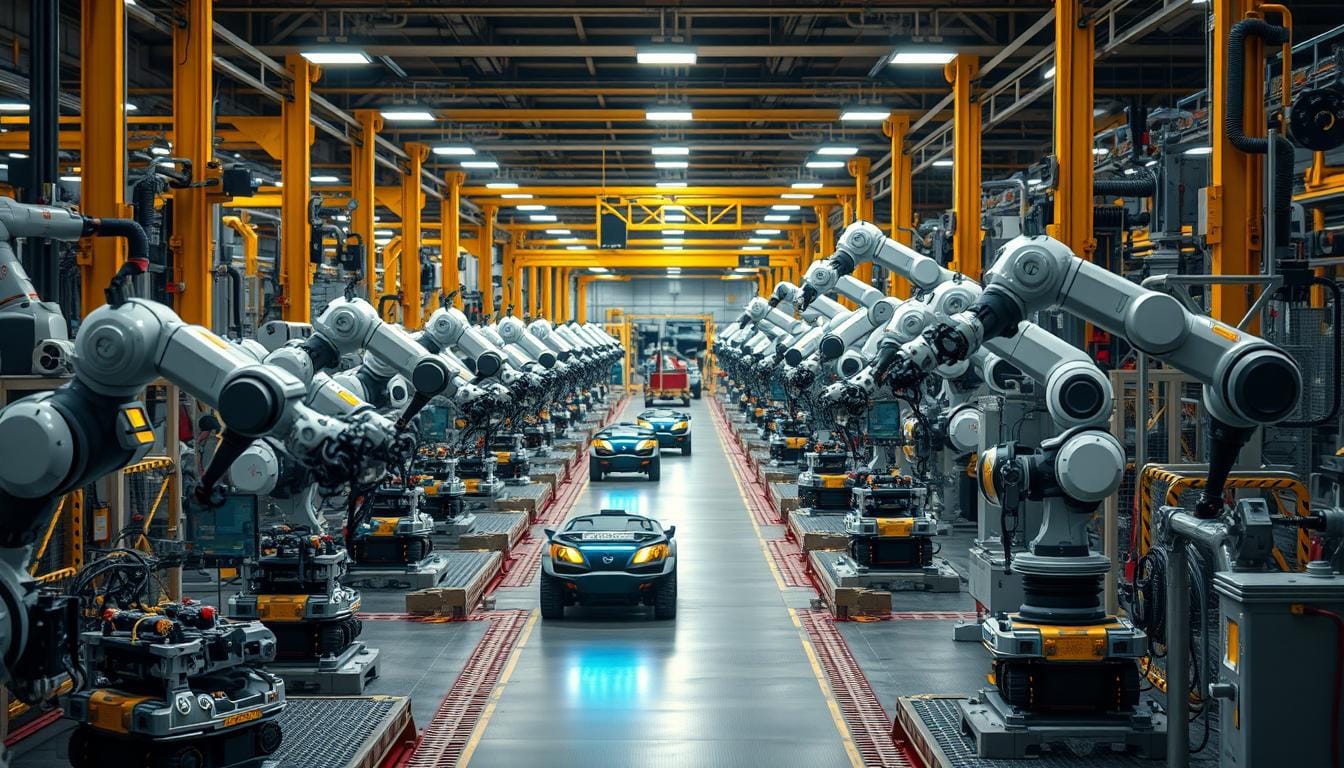
The shift in modern manufacturing is clear. In 2023, about 4,281,585 industrial robots were active worldwide, showing fast adoption across sectors. These machines deliver consistent precision and speed while running around the clock to meet demand.
This guide maps a path from core definitions and components to kinematics, types of systems, and practical applications. You will find clear examples of welding, painting, assembly, pick-and-place, packaging, inspection, and testing.
We explain how to choose the right robot or machine by matching types to tasks, performance needs, and site limits. The focus is on throughput, quality, and labor optimization so automation supports business goals.
Readers will get action-oriented advice on programming, safety, costs, and ROI. By the end, you will know where speed and precision matter most and how to balance them with integration and workforce upskilling.
Key Takeaways
- Global deployment is growing fast, with millions of units in use.
- Robots boost throughput and repeatable quality for many manufacturing tasks.
- Choose systems by matching types to specific applications and constraints.
- Automation strategies must align with business goals and workforce plans.
- Practical examples make technical choices easier to act on.
What Are Industrial Robots? A Clear Definition and Why They Matter Today
A programmable system built for repetitive production work is the simplest way to define an industrial robot. These units move on three axes or more and rely on joints and axes to shape motion and reach.
Typical parts include a manipulator arm, a controller that runs the motion plan, sensors that monitor position and force, and an end effector that performs the specific task. Together they enable welding, painting, assembly, pick-and-place, inspection, and testing.
How do factory systems differ from general-purpose machines? Duty cycles, payloads, and application tuning make production systems heavier duty and focused on throughput. In contrast, cobots trade raw speed for safe human collaboration and simpler setup.
Why three axes matter: three is the minimum for basic spatial motion. Adding axes expands the workspace and gives finer orientation control for complex parts. Sensors then feed back corrections so the system keeps quality steady in variable conditions.
- Programmable motion across multiple axes
- Arm, controller, sensors, and end effector work as one system
- Designed to raise quality, cut variability, and free people for higher-value work
The State of Industrial Robotics in the Present Day
Adoption rates for automated machinery now measure in the millions, signaling a watershed for manufacturing. The latest global number reports 4,281,585 industrial robots in operation in 2023, a clear sign that scale and maturity have arrived across many operations.
Global adoption and investment momentum
Companies plan to direct roughly a quarter of future capital spending into robotics and automation. This investment tailwind supports a market expected to approach $43 billion in revenue by 2027.
Robot-to-human ratios and labor impact
Estimates show more than 3.4 million units in some counts, yielding a robot-to-human ratio near 1:71 in manufacturing. That ratio reshapes workforce planning, productivity benchmarks, and competitive positioning, especially in the U.S.
Where deployments keep growing
Example sectors expanding use include automotive, electronics, food, pharma, and logistics. Drivers are consistent: labor availability, quality control, and faster throughput in time-sensitive environments.
“Use cases evolve as control software and sensors improve, letting more processes become automatable.”
- Scale: millions deployed worldwide and rising.
- Investment: higher CAPEX share toward robotics and automation.
- Regional differences: adoption speed varies with regulation and training programs.
Inside the Machine: Key Components and Design Fundamentals
Inside every manufacturing cell, a tight network of controllers, drives, and arms turns design into repeatable action. That network links the computer that times each move to the mechanical parts that do the work.
Controller, drives, and motion control
The controller orchestrates I/O and motion profiles so the machine hits path, speed, and orientation targets. Drives—usually electric today—shape acceleration and cycle time and affect path quality.
Robot arm, joints, and degrees of freedom
The manipulator combines links and joints to set axes and workspace. Design choices change rigidity, payload, and accuracy, so pick an arm that matches the parts and payload you need.
End effectors and quick-change tooling
End effectors convert a generic arm into a task tool. Common end tools include grippers, weld guns, and sprayers for assembly and finishing. Quick-change mounts speed retooling and increase flexibility.
Sensors and machine vision systems
Sensors and vision close the loop by guiding pick points and verifying presence. For example, a camera can correct pose before the end tool touches a part, raising yield and cutting rework.
Safety note: teach pendants include a three‑position deadman switch to protect technicians during manual use.
Kinematics, Axes, and Motion: How Robots Move with Speed and Precision
Kinematics and axis layout shape what a machine can reach and how it orients a tool. Two axes let a tool move in a plane; three axes access any point in space. Full orientation control typically needs six degrees of freedom (yaw, pitch, roll).

Three axes vs. six DoF
Three axes give simple reach but limited orientation. Six DoF adds wrist joints so the end tool can angle precisely for assembly or welding.
Choose three axes for straight pick-and-place paths. Use six DoF when orientation affects fit, finish, or inspection.
Serial versus parallel architectures
Serial manipulators stack links and joints along an arm. They offer wide work envelopes and flexible trajectories but can flex under load.
Parallel architectures use multiple chains to support the end effector. That layout raises stiffness and enables ultra-high speed pick cycles with high repeatability.
- Design and joint layout define the working envelope and path quality.
- Motion profiles and trajectory planning control cycle time and surface quality.
- Trade-offs: prioritize speed for high-throughput pick tasks; choose precision where tight tolerances matter.
Example: a serial robot follows a welding path with smooth continuous motion. A parallel system handles ultra-fast pick-and-place with shorter cycle times and higher stiffness.
Types of Industrial Robots and When to Use Each
Robot types differ in motion layout, and that choice drives fit-for-purpose performance.
Articulated robots
Articulated robots mimic a human arm with rotary joints and multiple axes. They excel when you need flexible paths, complex orientation, or higher payloads for tasks like welding and heavy assembly.
Cartesian (gantry) systems
Cartesian machines use linear prismatic joints for straight-line moves. Choose these when you need rigid, repeatable pick-and-place or precise machine loading across a rectangular work envelope.
Cylindrical and spherical (polar) designs
Cylindrical units mix rotation and linear travel to reach into tight cells. Polar or spherical types give a wide, globe-like envelope for parts that require sweeping access with fewer base movements.
SCARA and delta specialists
SCARA robots deliver very fast lateral motion and dominate bench-top assembly of small parts. They offer quick cycles and compact footprints.
Delta robots use parallel linkages and base-mounted motors for blistering top-end pick-and-place speed with minimal moving mass.
Practical note: match the kinematics to part size, place accuracy, and material presentation. Proper fixturing and integration make each type perform as designed.
- When to pick an articulated arm: flexible paths, orientation control, and heavier payloads.
- When to pick Cartesian: straight-line accuracy, rigidity, and simple pick-and-place routines.
- When to pick SCARA/Delta: small-part assembly or ultra-fast pick cycles where cycle time wins.
Core Applications Across Manufacturing
From assembly to inspection, modern automation shifts routine chores off the line and into controlled motion. Manufacturers deploy applications that cut cycle time, raise quality, and free staff for higher-value work.
Assembly, dispensing, and material handling
Assembly cells place components, dispense adhesives or sealants, and handle parts between stations. Motion profiles and place accuracy determine final fit and rework rates.
Welding, painting, and coating
Consistent torch or spray motion keeps heat input and coating thickness steady. That improves finish quality, reduces overspray, and enhances operator safety in enclosed booths.
Picking, sorting, packing, and palletizing
Pick, sort, pack, and palletize lines rely on vision-guided pick place flows and a range of end effectors. Grippers, suction, and conveyors handle product variability for fast throughput.
Machine tending and CNC operations
Robotic tending loads parts, opens doors, and queues tools to maximize CNC uptime. Standardized routines cut idle time and simplify shift handovers.
Inspection and quality control with vision
Vision systems perform dimensional checks and surface defect detection in real time. Automated rejection maintains product quality and reduces manual inspection labor.
Sector examples and flexibility
Automotive lines use heavy payload arms for assembly and welding. Electronics favor small-part assembly and precise pick place cycles. Food and pharma add hygienic tooling and validated cleaning protocols.
Pro tip: standardized routines speed reprogramming so the same cell can adapt to new SKUs with minimal downtime.
- Map applications to tasks: select motion, tooling, and vision to meet product specs.
- Where pick place speed defines throughput, prioritize presentation and end effector choice.
- Use consistent cycles to improve safety, uptime, and repeatability across operations.
industrial robots: Performance Metrics That Matter
Performance metrics turn vague claims into measurable requirements that guide cell design and purchasing.
Payload, speed, acceleration, and MTBF
Payload, speed, and acceleration set cycle time and affect path quality and tooling choice for the end effector.
Higher payloads slow nominal speed and raise inertia; that can blur precision at corners and increase wear. Brands often quote MTBF in the 40,000–100,000 hour range to signal reliability and plan maintenance.
Accuracy vs. repeatability under ISO 9283
Accuracy is position error from a true point. Repeatability measures standard deviation when returning to a taught pose. ISO 9283 gives a comparable test method at rated speed and payload.
Repeatability usually matters more in production because parts must be placed the same way every cycle.
Tip: use calibration, vision guidance, and tuned trajectories to improve real‑world precision and compensate for envelope effects.
- Specify metrics to match part tolerance and takt time, not marketing peaks.
- Axes layout and structural stiffness shape dynamic precision, crucial for continuous-path tasks like welding.
- Smooth trajectory planning balances speed with consistent repeatability.
Safety, Compliance, and Human Collaboration
Managing human‑machine interaction takes deliberate design, verified controls, and regular checks. A solid safety plan begins with a risk assessment that maps hazards, exposure frequency, and potential severity.

Risk zones, cages, and emergency stops
Define safety‑rated zones and add interlocks for physical barriers. Use hardwired emergency stop circuits with clear labeling and routine test procedures.
Install light curtains or area scanners where gates are impractical. Document each safeguard and include it in your lockout/tagout program.
Cobots vs. traditional cells: sensing and safe modes
Cobots rely on force/torque limits, built‑in sensors, and safe motion profiles to stop on contact. Traditional fenced cells use interlocks and teach pendants with a three‑position deadman switch for manual moves.
Choose the deployment that matches workflow, operator proximity, and required throughput.
Designing safety functions and ongoing compliance
Combine light curtains, area scanners, safe stops, and validated software to create multi‑layer protection. Run validation testing after any change in tooling or layout.
Safety is not a one‑time setup; it is a continuous process of verification and training.
- Perform periodic inspections and document results.
- Train operators on teach pendants and emergency response.
- Balance throughput with ergonomics to minimize human exposure.
Programming and Integration: From Teach Pendant to Offline
From handheld teaching to full offline simulation, programming defines how tasks run day to day. This section shows practical methods to make cells repeatable and maintainable across shifts.
Teach pendant, lead-through, and positional commands
Operators program with a teach pendant for fast setup and safe jogging. Pendants include speed control and a deadman switch for manual moves.
Lead-through teaching speeds initial setup: guide the arm by hand, capture poses, and store them as reusable routines. Positional commands allow tight control for accurate place points.
Workcells, PLCs, and synchronizing peripherals
Integrate robots with a PLC or controller so feeders, molding or CNC machines, and inspection devices run in sequence. Use handshakes and timed I/O to prevent collisions and lost parts.
Best practice: structure tasks into modular routines, add vision triggers for verification, and define clear error‑recovery states.
- Simulate and deploy code from a PC to validate timing and edge cases.
- Version control and backups simplify troubleshooting and future changes.
- Sync conveyors and machines with deterministic signals to cut idle time.
Costs, ROI, and Total Cost of Ownership
Upfront and ongoing expenses shape whether automation pays back in weeks or years. Entry-level units commonly range from about $25,000 to $400,000 for a single robot. Beyond that sticker price, integration, workspace redesign, and training add to initial cost.
Entry pricing, integration, and training factors
Budget for hardware, end effectors, fixturing, safety barriers, and controller upgrades. Add integrator fees and PLC or vision hookups.
Training and ramp time are real expenses. Plan for operator and maintenance classes, plus lost productivity during the learning curve.
Productivity gains, quality, and operating cost reductions
Model payback by quantifying cycle time cuts, yield improvements, and scrap reduction. Use realistic numbers: small cycle gains across many shifts compound quickly.
Include reduced injury-related costs and extended MTBF figures (40,000–100,000 hours) to estimate fewer unplanned stops. Reserve budget for spares and preventative maintenance.
Practical approach: run a phased deployment. Start with one cell, validate metrics, then scale standardized programs across similar product families to accelerate payback.
- Total cost of ownership: hardware + integration + fixturing + safety + training + maintenance over time.
- Risk factors: frequent changeovers, part variability, and long trainer time can delay returns.
- Business case: build a 1–5 year horizon with conservative cycle time and yield assumptions; include spares, routine service, and incremental upgrades.
Trends Shaping the Next Era: AI, Vision, and Industry 4.0
AI, vision, and fast networks are rewriting how factory systems see variation and act on it. Machine vision plus learning models let a cell detect part shifts, correct pick points, and adjust paths without manual retuning.
From fixed automation to adaptive autonomy
Fixed programs once defined every move. Now, perception and on‑device AI allow a robot to adapt trajectories and force in real time.
That adaptive autonomy reduces downtime for changeovers and improves yield on varied parts.
Cloud, 5G, and data-driven optimization
High‑speed links and cloud analytics collect telemetry across cells. Teams use that data to tune cycle time, balance lines, and deploy model updates faster.
Integration with MES and ERP gives end-to-end visibility so throughput aligns with orders and inventory signals.
Practical tip: start with a single pilot cell, stream telemetry to a secure cloud service, and validate predictive alerts before scaling.
- Predictive maintenance: telemetry flags wear and schedules service to boost uptime.
- Modular cell design: quick-change fixtures and standardized interfaces enable short runs.
- Welding and precision assembly benefit from smarter sensing, force control, and on-the-fly tuning.
Security and reliability must accompany any AI rollout. Use segmented networks, encrypted telemetry, and tested rollback paths to keep the system stable while you innovate.
Conclusion
Combining precise motion, repeatable cycles, and connected data delivers measurable gains on the floor. Industrial robots now bring speed, endurance, and accuracy to a wide range of applications, from assembly to inspection.
Start with fundamentals: match components, kinematics, and tooling to the specific tasks that matter. Pilot one cell, verify metrics, then standardize controls and safety before scaling.
Measure what counts — repeatability, uptime, and total cost — using ISO methods and disciplined change control. Practical gains come from the arm, smart end tooling, and data-driven tuning that keep quality high and costs low.
Roadmap: pilot, standardize, scale. That path captures cumulative benefits while keeping operations safe and competitive.
FAQ
What is a programmable, automated machine with three or more axes?
It’s a mechanized arm designed to move along multiple axes under program control. These systems use motors and drives to position an arm and an end effector precisely for tasks such as pick‑and‑place, welding, or assembly. They operate autonomously once programmed and can repeat complex motions with high speed and consistency.
How do industrial robots differ from general-purpose robots and collaborative robots (cobots)?
General-purpose robots serve broad research or service roles and may lack heavy-duty actuation and safety certifications. Cobots prioritize safe human interaction with force limiting, lightweight design, and simplified programming. Traditional manufacturing arms focus on payload, speed, and sealed enclosures, often requiring safety cages and control integration with PLCs.
How widespread is current global adoption and investment in manufacturing automation?
Adoption has grown steadily: millions of automated arms operate worldwide across automotive, electronics, food, and pharmaceutical plants. Investment continues to rise as companies pursue higher throughput, consistent quality, and labor cost insulation through targeted automation projects and modernization funds.
What does the robot-to-human ratio mean and how does the U.S. compare?
The ratio measures deployed arms per 10,000 manufacturing workers. Higher ratios indicate more automation per worker. The U.S. lags some highly automated countries like South Korea and Germany but has been increasing deployment in advanced sectors such as semiconductor and automotive supply chains.
What are the key control and motion components inside these systems?
Core parts include the controller (brain), servo drives and motors (actuation), motion controllers (trajectory planning), and safety I/O. Together they coordinate joint motion, manage feedback loops, and interface with PLCs, vision systems, and end‑of‑arm tooling.
How do arm design, joints, and degrees of freedom affect capability?
Joints (rotary or linear) define degrees of freedom (DoF). More DoF—commonly six—gives full orientation and position control for complex assembly. Fewer axes limit orientation but can improve rigidity and cycle speed for simpler tasks.
What are end effectors and how does quick-change tooling help?
End effectors are task-specific tools like grippers, welding torches, or dispensing guns. Quick‑change systems shorten downtime by letting technicians swap tooling without full recalibration, increasing flexibility across short production runs.
Which sensors and vision systems are common for inspection and guidance?
Typical sensors include encoders, force/torque sensors, proximity switches, and 2D/3D cameras. Machine vision enables part detection, OCR, and defect inspection, while depth cameras and laser scanners support bin picking and collision avoidance.
What’s the difference between three-axis and six-degree-of-freedom systems?
Three-axis setups allow movement along X, Y, Z, suitable for straight-line pick‑and‑place. Six‑DoF arms add roll, pitch, and yaw, enabling complex orientation tasks like welding seams or inserting fasteners into angled holes.
How do serial and parallel architectures compare in motion performance?
Serial arms stack joints in series for large work envelopes and dexterity. Parallel robots use multiple linkages working together, offering higher stiffness and speed for limited envelopes—ideal for high‑speed pick‑and‑place.
When should a manufacturer choose an articulated arm versus a SCARA or delta type?
Choose articulated arms for reach and complex manipulation. SCARA suits fast lateral assembly and insertion. Delta excels at very high‑speed vertical pick‑and‑place in packaging lines. Selection depends on payload, cycle time, and workspace geometry.
What are Cartesian (gantry), cylindrical, and spherical robot strengths?
Cartesian gantries deliver high linear accuracy across rectangular work areas and scale well for large parts. Cylindrical robots reach into tight radial spaces with compact footprints. Spherical (polar) units provide broad, curved envelopes for specific reach patterns.
What primary tasks do these systems handle on the factory floor?
Common tasks include assembly, dispensing, material handling, welding, painting, picking and packing, machine tending, and automated inspection. They boost throughput and consistency in sectors like automotive, electronics, food processing, and pharmaceuticals.
Which performance metrics matter most when specifying a system?
Focus on payload, maximum speed and acceleration, repeatability and accuracy per ISO 9283, and mean time between failures (MTBF). These metrics determine if a model meets cycle‑time and durability expectations.
What’s the difference between accuracy and repeatability under ISO 9283?
Accuracy measures how close a tool center point comes to a commanded position. Repeatability describes how consistently it returns to the same position. For most production tasks, repeatability is the critical spec for part-to-part consistency.
How do manufacturers protect people around fast-moving machinery?
Safety uses layered measures: guarded zones, light curtains, safety mats, interlocks, and emergency stops. Risk assessments define protective measures. For collaborative modes, certified force‑limiting control and speed restrictions allow closer human interaction.
How do cobots achieve safer human collaboration compared with traditional arms?
Cobots include compliant actuation, force sensing, and safety-rated control that limits forces and speeds. They use built‑in safety functions and simplified programming to reduce the need for hard guarding in low‑risk tasks.
What programming options exist from teach pendant to offline simulation?
Operators use teach pendants for direct point teaching and lead‑through methods. Offline programming and simulation tools let engineers develop and validate trajectories on a computer, reducing commissioning time and line downtime.
How do workcells, PLCs, and peripherals synchronize in a production line?
The robot controller exchanges signals with PLCs and peripheral devices via fieldbus or industrial Ethernet. Coordinated I/O and deterministic communication ensure timed handoffs between tools, conveyors, sensors, and vision systems.
What are typical cost factors and ROI considerations?
Costs include initial equipment, integration, tooling, safety, training, and maintenance. ROI depends on cycle time improvements, defect reduction, labor replacement, and increased uptime. Detailed payback models consider all life‑cycle expenses.
How do integration and training affect total cost of ownership?
Skilled integrators reduce commissioning risk and optimize cycle times. Operator training lowers programming errors and downtime. Poor integration or lack of training can inflate operating costs and delay ROI.
How are AI, vision, and Industry 4.0 shaping future automation?
AI and advanced vision enable adaptive part handling, quality prediction, and autonomous correction. Cloud connectivity and 5G support real‑time analytics, remote monitoring, and fleet optimization for smarter, data‑driven operations.
What moves automation from fixed programs to adaptive autonomy?
Techniques like machine learning, sensor fusion, and edge computing let systems adjust trajectories, handle variable parts, and compensate for process drift—reducing manual reprogramming for new SKUs.
How do cloud platforms and faster networks improve system performance?
Cloud services aggregate production data for predictive maintenance and continuous optimization. High‑bandwidth, low‑latency networks like 5G enable synchronized multi‑cell control and remote diagnostics, shortening downtime and improving throughput.